“We’re fiddling here, and Rome is burning.”
By Laura Slot, December 2008 ~ 9 minute read
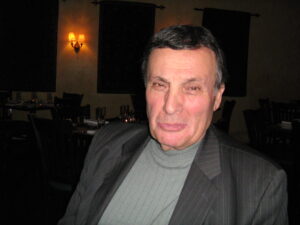
On a bright Monday morning a few weeks ago, a tall, 80-year-old man named Buddy Scotto – Salvatore, his real name, is never used – got in his hybrid Toyota Prius to do his “round” through his neighborhood Carroll Gardens, Brooklyn, and its surroundings.
While slapping the dashboard and cursing the built-in seatbelt alarm, the majestic man who some people call “the mayor” of Carroll Gardens, talked vigorously about the daycare school, the senior center and the other local non-profit organizations he founded in the 1960s and 1970s to improve the neighborhood.
Dressed in a black blazer with shoulder pads that made his figure seem even broader, Scotto enthusiastically shook hands on Court Street with the “old timers”; the generation of Italian-Americans he grew up with. Without a grey hair or a wrinkle in sight, Scotto looked years younger than his age.
Ladies with walkers looked up in surprise and waved to him from across the street. A small group of men wearing gold necklaces who were chatting in Italian accents outside Monteleone’s pastry shop made peace signs with two fingers and yelled to him “pace e bene” – peace and all good.
A Perfect Neighborhood
For five decades the community activist, who still runs the funeral home his father had started in 1926, has been articulately lobbying on all political levels for development, infrastructure, and affordable housing. But his longheld ideal of the perfect neighborhood, a dream he said comes “pretty close” to utopia, has increasingly been stirring controversy among residents who fear the quiet and cozy character of their brownstone blocks could be lost forever.
“He has a lot of connections with the older residents of Carroll Gardens who still accept him as the patriarch of the neighborhood,” said Katia Kelly, a 47-year-old resident who has lived in the neighborhood for 25 years. “But he does not speak for a big part of Carroll Gardens.”
Older Italian-Americans seem to admire Scotto’s passionate pursuit of the 12-story apartment complexes along the Gowanus Canal, a plan recently approved by the New York City Department of City Planning. But many residents who arrived in the neighborhood during the first wave of gentrification, in the early 1980s, feel more protective of their expensive brownstone homes and romantic leafy streets.
“They’re throwing rocks at me, because I want the development,” Scotto said, biting the knuckles of his hand with his teeth in frustration. Yet the charismatic Italian-American gentleman readily receives support from many New York politicians. “He’s a visionary,” Brooklyn Borough President Marty Markowitz, who has known Scotto for years, said cheerfully after a recent meeting in Borough Hall. “He believed in the future of Brooklyn long before the hip and chique.”
Growing Critique
Scotto’s close ties with politicians and developers have made other residents suspicious, and some question whether he has a personal financial stake in his lobbies. A few of his critics gossip about him anonymously on the internet, and others vent their emotions at local meetings.
“In order to make his personal dream become reality he will basically do anything, including stalking the community board,” said Kelly. “The guy has unbelievable clout with politicians, but they are starting to realize there is this other group of residents that is giving them trouble. I think Buddy realizes it, too.”
Kelly, who writes a popular blog about Carroll Gardens entitled Pardon Me for Asking, said Scotto and the politicians who work with him can expect more resistance. “A whole new movement of people is getting involved,” she said. “We’re not standing by and letting this happen.”
Some residents, like Kelly, argue that the heavily polluted soil along the Gowanus Canal, the large inlet in between Carroll Gardens and Park Slope, should be cleaned up before anything is built, and others protest against the 12-story height of the project.
The Carroll Gardens Neighborhood Association, where Scotto is vice president, decided in January that his funeral home would no longer be their monthly meeting place, as the group wanted to distance itself from his views, Kelly said. “He realizes that the neighborhood has become very politically active, because many people feel it has been assaulted by developers,” she said. “Who was making these deals? We felt disconnected.”
During a meeting with the New York City Department of City Planning in Manhattan, it was Scotto who amicably socialized with officials, Kelly said. “He knows all these developers, they shake hands, and he has lunch with them, it makes me uneasy.”
A Matter of Pride
Upon Scotto’s return from the Korean War, where he was a platoon sergeant in 1950, he changed his plans about making the Army his career and instead took over his parents’ funeral home.
After deciding to stay in Carroll Gardens, Scotto saw the potential of his neighborhood and became “electrified with the challenge” to improve scruffy areas like Gowanus and the Columbia Street District, aiming to stop his generation of Italian-Americans from moving away to the suburbs. “I’m not saying we stopped the Italians from leaving the neighborhood,” he said during a Sunday lunch with fellow Italian-Americans in the back room of Casa Rosa restaurant. “But we really slowed it down.”
While eating his salad, Scotto recalled being invited to the White House by former Vice President Nelson Rockefeller while he lobbied for a cleanup of the Gowanus Canal in 1976, and his stroll around the neighborhood with philanthropist and novelist Brooke Astor, who died in August last year.
Vincent Geritano, a 63-year-old retired longshoreman who was born in the neighborhood, said he admires Scotto’s efforts. He remembers that the smell of the Gowanus Canal in the 1960s was so pungent that his family, living ten blocks away from the water, had to keep their windows closed. “He’s doing great work for Carroll Gardens,” said Geritano. “He’s an activist, he gets things done and he has the neighborhood at heart.”
Until the 1960s Carroll Gardens was considered part of Red Hook, where thousands of Italian-American longshoremen worked rough jobs on the Brooklyn waterfront. Scotto still remembers the days when Italian-American dockworkers dreamed of moving away as quickly as possible in order to have better living conditions. Improving the neighborhood therefore became a matter of pride, he said. “Those Depression years were really tough,” Scotto said of his 1930s childhood. “My mother cut out cardboard to put in my shoes, hoping that it wouldn’t rain.”
Times have certainly changed since then. The working-class immigrant neighborhood has transformed into one of Brooklyn’s most trendy areas with an overabundance of fancy clothing stores and exotic eateries on Smith Street’s “restaurant row”. An average one-bedroom apartment now rents for $2,000 a month.
Striving for Perfection
Despite the gentrification the area has already seen, Scotto continues to strive for improvements, and his vision has remained similar to the one he started out with during the 1960s. “It’s going to be that real, balanced community,” he said while driving around. “We’ve got Red Hook low income housing that takes care of our low income people, we’ll have affordable, which will take care of our middle income people, and we’ll have market housing for upper income, too.” Then, after a brief pause, he added, “we can really have a perfect, integrated community downtown. It’s just amazing, the opportunity that we have.”
Scotto’s 43-year-old daughter Debra, who is an attorney and broker in Carroll Gardens, said it’s inspiring to watch her father’s pursuits. “He’s always ahead of the curve,” she said. “I hope I inherit the gene, he’s got an extraordinary amount of energy.” The rumors about hidden agendas are silly, she said. “He’s a local businessman. A lot of funeral home owners get involved; he just took it to a further degree.” Like her father, Scotto waves away the claims of worried residents who think that more growth will harm the neighborhood’s historic character. “Change is the only constant,” she said. “Development has always been welcome. A lot of people have their own agendas.”
Angela Vita, who has been a broker and owner of Vita Real Estate in Carroll Gardens for 25 years, disagrees. “His [Scotto’s] attitude is, everyone who is against the height of the buildings is against development,” she said. “That’s not true. I’m in real estate, why would I be against development? I am against having a building next to my building that is 12 stories high.” Like Kelly and many other residents, Vita is concerned about the future of the area. “It would change the looks of the neighborhood,” she said firmly. “We’re Carroll Gardens and that’s the way we like it.”
No End in Sight
Last Thursday afternoon, Scotto, wearing a long grey trench coat, a black beret, and a cloud of crisp cologne, stepped into a board room in a Lower Manhattan skyscraper. With engineers, local lobbyists and federal officials he talked about a $15 billion tunnel replacing Robert Moses’ Gowanus Expressway, a project planned for completion somewhere between 2020 and 2050.
After a detailed PowerPoint presentation on the project’s progress, Scotto raised his voice like an impatient school teacher, nervously tapping his fingers on the conference table. The amounts of people moving into Brooklyn require a better infrastructure sooner, he told the group, throwing his hands in the air. “We’re fiddling here, and Rome is burning.”
But Scotto said he realizes that a healthy dose of patience and confidence could eventually pay off. “It will take some time,” he said about the tunnel. “I’ve been on it seven years. Usually it takes 15 to 20 years to get these things done.”
Although he does not like to be reminded of his age, Scotto has no intentions of slowing down. His wife has been pushing for longer weekends and vacations with their eight-year-old granddaughter, he said, but lobbying keeps him young.
While driving home at night in his Toyota, Scotto briefly reminisced the days before he became a thirty-something community activist. “I wasn’t aware, really, of how much love and feeling I had for my community and my neighborhood,” he said, gazing in the darkness. “I didn’t understand that, until I started to exercise it. And I really got carried away with it, I guess.”